Styling guide
Styling Books Horizontally vs Vertically: When to Use Each
Use both: vertical runs and horizontal stacks do different jobs, and combining them is what turns a shelf of books into a styled shelf. Here's when to use each and how to put them together.
Vertical (upright) books
What they do: create a strong, orderly line that reads as "library." Upright runs cover the most shelf length and show off spine color.
Use vertical when: - you want a full, collected look, - you're color blocking and want long runs of a single color, - the shelf is tall enough for books to stand with about an inch to spare, - the shelf is shallow (upright books need less depth than flat ones).
Tips: - Group books of similar height. It looks tidy and, according to the Library of Congress, it's better for them: shelving similar sizes together means each cover is supported by its neighbors. - Keep them straight. The Library of Congress advises that shelved books should not lean; use a bookend, the side of the case, or a horizontal stack to hold the end of a run. - Try a stepped run: arrange from tallest to shortest for a gentle slope at the end.
Horizontal (stacked) books
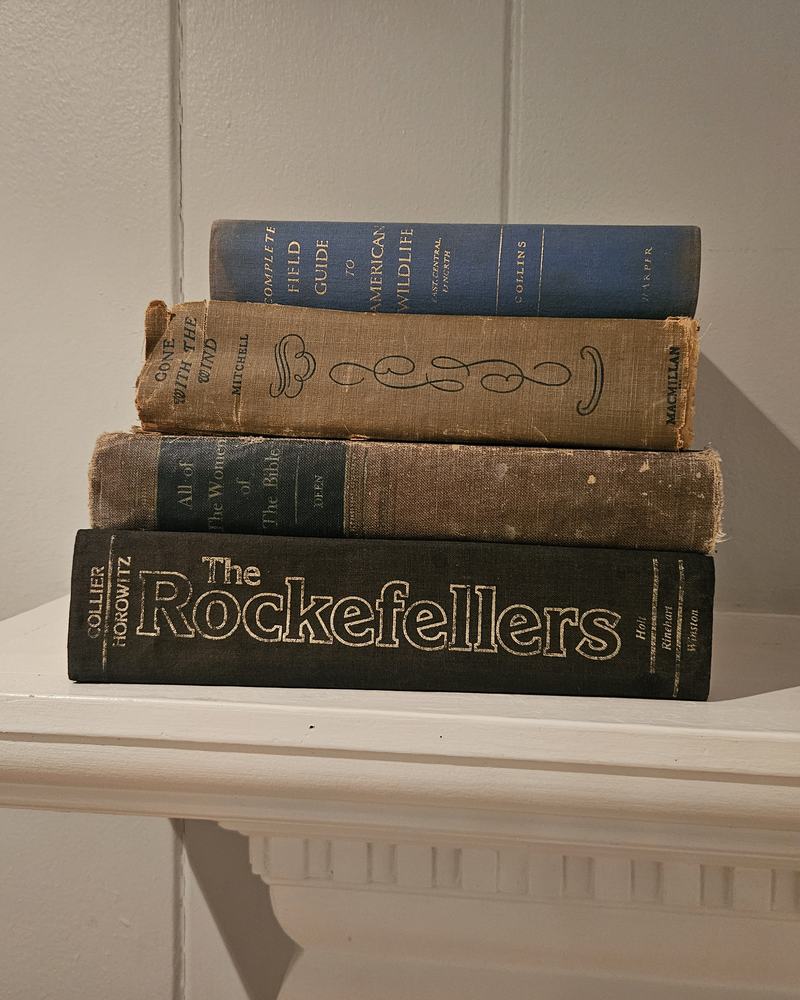
What they do: add a different shape, break up long lines, and act as a pedestal for objects.
Use horizontal when: - the shelf is too short for books to stand upright, - you need to end a run without a bookend, - you want to lift a small object (candle, vase, small plant) to a better height, - the shelf is very tall and upright books would leave empty space above them, - you're working with large, heavy art books. The Library of Congress notes that books too large to stand upright can be stored flat and horizontal, fully supported by the shelf.
Tips: - Stack three to five books, largest at the bottom. - Turn spines out so they show color. - Align edges for a crisp look or stagger slightly for a relaxed one. - Keep stacks low enough that you can lift the top books easily.
Side-by-side comparison
| Vertical | Horizontal | |
|---|---|---|
| Look | Orderly, library-like | Relaxed, sculptural |
| Shelf width used | More | Less (about the width of the largest book) |
| Shelf height used | More | Less per book, grows with stack |
| Shelf depth needed | Less | More (book width) |
| Holds objects | No | Yes, as a riser |
| Best for | Color runs, full shelves | Short shelves, breaking up lines, styling objects |
How to combine them on one shelf
The most reliable styled shelf uses three elements: an upright run, a horizontal stack, and one object.
Common arrangements:
- Run + stack as bookend: an upright run leaning into a horizontal stack at its end.
- Stack + object: a stack on one side with a vase on top, an upright run on the other.
- Run + object + run: two short upright runs with an object between, for wide shelves.
- Stack only: a single stack with an object, for an airy shelf at eye level.
The zigzag rule
Across a whole bookcase, alternate where the stacks fall: left on shelf 1, right on shelf 2, left on shelf 3. Do the same with your largest objects. The eye follows the zigzag up the case, which feels balanced without being stiffly symmetrical. Full step-by-step method: how to decorate bookshelves with books.
Ratios that work
There's no rule, but a rough starting point for a living room bookcase:
- about two-thirds of books upright and one-third in stacks,
- one stack on most shelves,
- one shelf that's almost all upright (usually the bottom),
- one shelf that's mostly stack and object (usually eye level).
For a more relaxed or minimalist look, increase the share of stacks. For a library look, go almost all upright.
Color tips for each orientation
- Upright runs show spine color in long blocks, so they're where your main color goes. A long run of Dunes cream and ivory or Tidewater navy reads as one confident stripe.
- Stacks show spines and a bit of cover edge. They're ideal for accent colors like Storm black and charcoal or Driftwood tan and for mixed-color looks.
- Ombre stacks (darkest at the bottom) look especially deliberate.
Shelf-by-shelf example
Here's how the two orientations might work across a 5-shelf, 30-inch bookcase:
| Shelf | Vertical | Horizontal | Object |
|---|---|---|---|
| Top | 12 in run, right | — | Small plant, left |
| 2 | 8 in run, right | Stack of 4, left | Candle on the stack |
| 3 | — | Stack of 3, right | Large vase, left |
| 4 | 12 in run, left | Stack of 3, right | Bowl on the stack |
| Bottom | Full-width run | — | — |
That uses about 3 to 3.5 feet of upright books plus three stacks of 3 to 4, roughly 4.5 feet of books in total.
Bookends: when you need them
You need a bookend wherever an upright run ends mid-shelf with nothing to lean on. Options:
- a horizontal stack (free and stylish),
- a heavy object like a geode, a bowl or a small sculpture,
- a classic metal or stone bookend.
The Library of Congress suggests book-sized bookends, or a hardcover placed next to the bookend, so the end book is fully supported.
What to avoid
- Spine-up storage. Don't stand books on their fore-edge with the spine facing the ceiling. The Library of Congress warns that over time gravity can loosen the text block from the cover.
- Very tall stacks. They topple and are hard to use. Keep shelf stacks to about five books.
- Leaning runs. They look sloppy and stress the bindings. End every run with support.
- Only one orientation. All upright can look like storage; all stacks can look like a pile.
Coffee tables and mantels
Off the bookcase, books are almost always horizontal. See coffee table book stacking ideas and mantel book styling.
Books for upright runs and stacks
River Birch Books sells real hardcover books by color in 1-foot and 2-foot lots for upright runs, plus 5-book coffee-table stacks, with free shipping to the continental U.S. Pick your palette from the books by color shop.
Frequently asked questions
Is it better to store books horizontally or vertically?
For most books, upright and straight is ideal, supported so they don't lean. Large books that won't stand upright are best stored flat and fully supported. The Library of Congress says both upright and flat storage are fine; leaning and spine-up storage are what to avoid.
How many books should be in a horizontal stack?
Three to five is the usual range on a shelf. It's enough to make a visible block and to serve as a riser for a small object, without getting too tall to pull from.
Should you mix horizontal and vertical books on a shelf?
Yes. Mixing is what makes a shelf look styled. A horizontal stack can end an upright run in place of a bookend, and alternating the stack's position from shelf to shelf creates a pleasing zigzag.
Do horizontal stacks fit more books on a shelf?
Not usually. A stack uses less shelf width but more height. On short shelves, stacks are the only option; on tall shelves, they fill vertical space that upright books would leave empty.