Styling guide
Book Photography Props: Styling Books for Photos
Hardcover books are some of the most useful props a photographer, maker or small business can own: they raise a product to the right height, add texture to a flat lay and set a mood (cozy, academic, coastal, vintage) in one move.
Below: which books work best, how to handle color, light and titles, and how to build a small prop kit.
Why books make great props
- Risers with character. A stack lifts a product off the table without looking like a plinth.
- Texture. Cloth spines and page edges add surface interest that plain backdrops lack.
- Mood in a glance. Worn brown spines say vintage; cream says clean and airy; navy says polished.
- Infinitely rearrangeable. Stack, fan, open, lean or line them up.
- Durable. Hardcovers survive repeated shoots.
Choosing books for photography
| Feature | Why |
|---|---|
| Hardcover | Stays flat and square as a riser |
| Plain or cloth spines | Fewer distracting titles and logos |
| One color family | Keeps the frame cohesive |
| Varied heights and thicknesses | Gives you options for levels |
| Matte finish | Less glare than glossy jackets |
Color-sorted lots solve the biggest problem, which is finding enough books that look good together. Dunes cream and ivory and Driftwood tan and soft brown are the most versatile neutral prop palettes. For an aged, collected feel, the Vintage-Look Shelf Collection comes in a 2-foot size.
Choosing a color for your subject
Contrast keeps the subject the hero:
| Subject | Book color |
|---|---|
| Candles, ceramics in white or pastel | Tan, navy or charcoal |
| Wood, leather goods | Cream |
| Gold or brass jewelry | Navy or charcoal |
| Skincare in clear or white packaging | Aqua, green or tan |
| Dark products | Cream |
| Food and drink | Tan or cream |
Our Storm black and charcoal books make bright products pop; Sea Glass aqua suits fresh, coastal or wellness brands.
Prop techniques
The riser stack
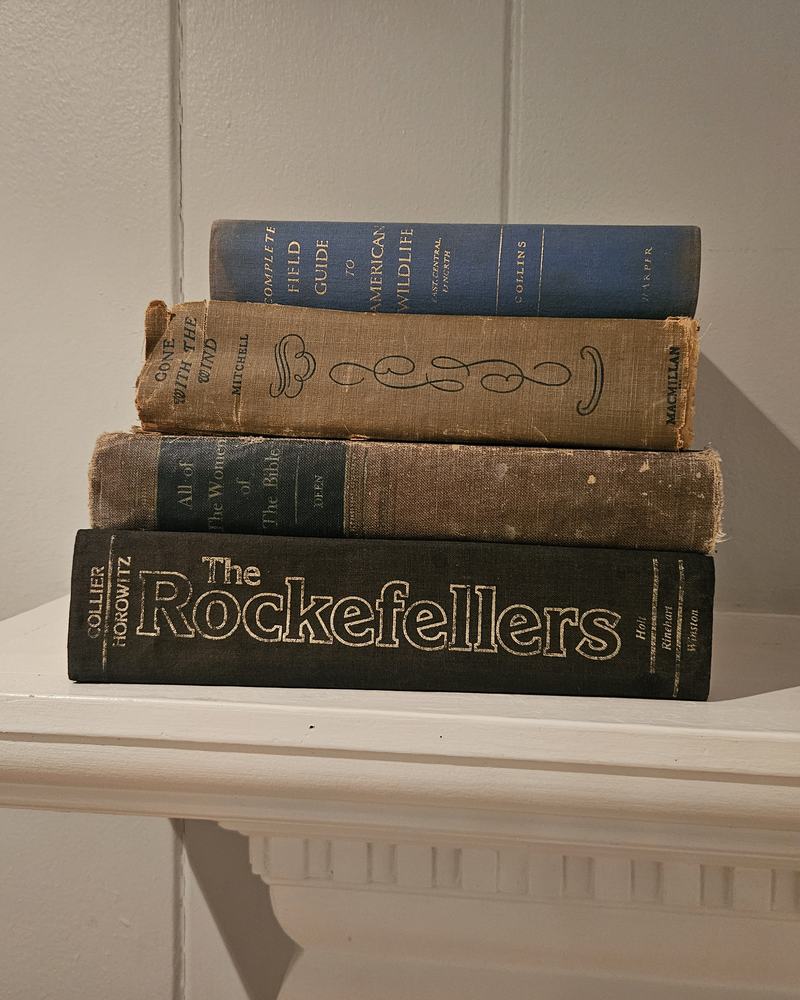
Stack two to four books, largest at the bottom, and place the product on top. Offset each book slightly for a relaxed look, or square them for clean product shots.
Mixed levels
Use two stacks of different heights to show a pair of products or a product and its packaging.
Open book
An open book with pages fanned adds softness and movement. Use it as a base for jewelry, a cup or flowers. Shoot the pages slightly out of focus so text doesn't compete.
Page edges forward
Turn spines away so only the page edges show. This hides titles entirely and gives a soft, pale texture. We cover the look in books spines backwards: pros and cons.
The flat lay
Lay one or two books flat as a base layer, overlapping the edge of the frame, then add the product and smaller props on top. Books ground a flat lay and add a second texture.
The bookshelf backdrop
For portraits, interviews and lifestyle shots, a styled shelf behind the subject adds depth. Keep it slightly out of focus and avoid shelves edging right behind someone's head. Our Zoom background bookshelf guide covers the same principles for video.
Handling titles and logos
Readable titles can distract or create unwanted associations, especially in commercial work. Options: - turn spines away from the camera, - remove dust jackets and use plain cloth covers, - shoot with a shallow depth of field so spines blur, - angle stacks so spines face sideways, - wrap spines in plain paper for a uniform look.
If you're making commercial images, keep an eye on recognizable cover art and publisher logos in the frame.
Light
- Soft window light from the side brings out cloth texture and page edges.
- Avoid direct, harsh sun on glossy jackets, which creates glare.
- Warm light suits brown and burgundy books; cooler daylight suits cream, navy and aqua.
- Bounce light with a white card to soften shadows under stacked products.
Repeated long sessions in strong sun can fade spines over time; the Library of Congress notes light damage is cumulative. Store prop books in a cool, dark, dry place between shoots, as the Library of Congress recommends for book storage.
Building a prop kit
| Kit | What to include | Use |
|---|---|---|
| Starter | One five-book stack in cream or tan | Product risers, flat lays |
| Versatile | Two stacks in contrasting colors (cream and charcoal) | Light and dark products |
| Lifestyle | One foot of books plus a stack | Shelf scenes, portraits |
| Studio | Several palettes, 1 foot each | Variety across clients |
Add a few non-book props to go with them: a linen napkin, a small vase, dried stems, a brass object, a ceramic cup.
Ideas by type of photographer
Product photographers and small brands
Keep a neutral riser stack for every shoot and a contrast stack for light products. Consistency in prop colors across a catalog makes a shop feel cohesive.
Portrait and family photographers
A stack of vintage-look books makes a natural prop for children to sit beside or hold, and for senior or graduate portraits. A shelf backdrop works for headshots.
Wedding and event photographers
Books show up in detail shots: rings on an open book, invitations on a stack. See vintage books for wedding decor.
Real estate and interior photographers
A coffee-table stack or a styled bookcase helps rooms look finished. See how to stage bookshelves to sell a house.
Content creators
Books make a quick backdrop refresh for videos and posts; swap palettes by season.
Composition tips with books
- Use the rule of thirds. Place a stack on a third line, not dead center, and let the product sit at an intersection.
- Lead the eye. A row of spines or a fanned stack can point toward the subject.
- Crop with confidence. Books cut off at the frame edge feel natural and suggest a larger scene.
- Repeat a color. Pick one color from the product (a label, a lid) and echo it in a single book.
- Leave negative space. Keep room for text if the image will be used in an ad or social graphic.
- Shoot a few angles. Straight-on works for stacks; overhead suits flat lays; a 45-degree angle shows both the product and the book texture.
Care between shoots
- Wipe off fingerprints and dust with a soft, dry cloth.
- Keep books away from food and drink props, or protect them with a placemat.
- Store upright with bookends or flat in a box, not leaning.
- Keep them out of hot cars and damp basements.
How many books do you need?
| Shoot type | Approximate |
|---|---|
| Single product riser | 2-4 books |
| Flat lay | 1-3 books |
| Two-level product scene | 5-8 books |
| Shelf backdrop | 2-4 ft |
Buy books for photo props
Our real hardcover lots are color-sorted for exactly this: a five-book stack is $39.99, 1 foot is $69.99 and 2 feet is $129.99 (Sea Glass: $42.99, $74.99 and $139.99), with free shipping to the continental U.S. Browse every palette in our decorative books shop.
Frequently asked questions
What books work best as photography props?
Hardcovers with plain or cloth spines in a single color family. They hold their shape as risers, don't distract from the subject, and photograph with natural texture.
How do you hide book titles in photos?
Turn spines away from the camera, shoot the page edges, remove dust jackets, use books with plain cloth covers, or angle the stack so titles fall out of focus.
What color books are best for product photography?
Choose a color that contrasts with your product. Cream and tan suit most products; navy and charcoal make light products pop; aqua and green work for fresh, natural brands.
How many books do I need for a photo prop kit?
A five-book stack in one or two neutral colors covers most product shots. Add a foot of books if you shoot bookshelf backdrops or lifestyle scenes.