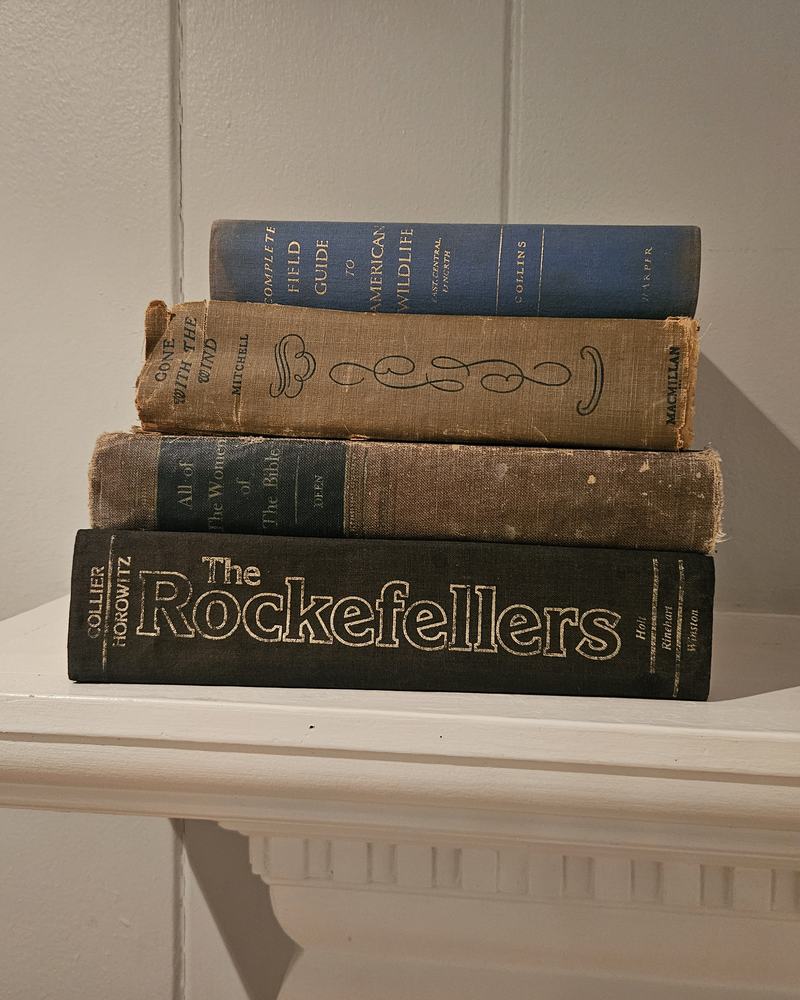
Styling guide
Fake Decorative Books vs Real Books: Which Look Better?
Real books look better up close, can be restyled and photograph naturally; fake decorative books (hollow book boxes, foam blocks with printed spines, blank-page "books") are lighter and can hide storage. Below: the two compared on looks, feel, weight, cost and practicality, and when each makes sense.
Types of fake decorative books
| Type | What it is | Common use |
|---|---|---|
| Book boxes | Hollow boxes made to look like a stack of books, often with a lid | Hidden storage on coffee tables and shelves |
| Faux spines or panels | A single piece printed or molded to look like a row of spines | Hiding cords or filling high shelves |
| Foam or resin books | Lightweight solid blocks with printed covers | Staging, events, high shelves |
| Blank books | Real bindings with blank or plain pages, styled to look vintage | Coffee tables, rustic decor |
Our white books for decor guide also compares painted books and books turned backward.
How they compare
| Factor | Fake decorative books | Real hardcover books |
|---|---|---|
| Look from across the room | Often convincing | Natural |
| Look up close | Uniform, printed, too perfect | Texture, variation, real page edges |
| Feel | Light, hollow or foam | Substantial |
| Weight | Light | Heavy; check shelf ratings |
| Can be opened or read | No (except blank books) | Yes |
| Hidden storage | Yes, with book boxes | No |
| Restyling flexibility | Limited; fixed shape | Restack, re-sort, move anywhere |
| Photographs | Can look flat or shiny | Matte and textured |
Where fake books fall short
Up close, they read as fake
Printed spines repeat patterns, edges are too clean, and colors are too even. On a coffee table, where people pick things up, the illusion breaks quickly.
They're fixed
A faux stack is one shape forever. Real books can become a run, a stack, a lamp riser or a riser for a vase, and move to a different room when you redecorate.
Glare and finish
Many faux books have a slight sheen that shows in photos and under lamps. Real cloth spines are matte.
Weight works against them
It sounds odd, but light books can look wrong. A faux stack slides when bumped, and a lightweight bookend can't hold a row of foam books neatly.
Where fake books make sense
To be fair, faux books have real uses: - Very high shelves no one sees up close. - Hidden storage. A book box on a coffee table hides remotes and chargers. - Weight-limited displays, like lightweight event backdrops or rented shelving. - Hiding cords behind a faux spine panel.
Why real books usually win for home decor
- They look right at every distance, including on a coffee table.
- They're versatile. Stack, stand, fan, swap.
- They suit every style, from modern to farmhouse to library.
- They photograph naturally, which matters for listings, rentals and social photos. See book photography props.
- They hold bookends and each other upright. The Library of Congress recommends shelving books upright rather than leaning; real books have the weight to stay that way.
The common objection to real books is that it's hard to find enough that match. That's the problem color-sorted lots solve: real hardcover books already grouped by palette, like Dunes cream and ivory or Storm black and charcoal.
Real books vs. blank vintage-style books
Blank books with aged-look bindings are popular on coffee tables. They're real bindings, but the pages are blank or decorative, so they look less authentic when opened, and they tend to come in a narrow range of sizes. If you want a collected, aged feel with real books, our 2-foot Vintage-Look Shelf Collection is a run of real hardcovers with a vintage feel.
Weight and safety with real books
Real books are heavy, which is part of why they look substantial. Plan for it: - Check ratings. Floating shelves and brackets have weight limits; follow them. - Mount into studs or use anchors rated for the load. - Anchor bookcases. CPSC's Anchor It campaign urges anchoring furniture to the wall. - Heavier books low. CPSC recommends storing heavier items on lower shelves.
For shelf-specific tips, see how to style built-ins and floating shelves.
Cost: compare like with like
Prices vary widely for both faux and real books. When comparing: - Price per foot, not per piece. A faux "stack" might replace only three or four books. - What you get. Real books can be read, restyled and reused across rooms. - Longevity. Real hardcovers kept out of direct sun and damp last for years. The Library of Congress recommends 30 to 55 percent relative humidity and minimal light exposure. - Shipping and returns. Check both before you buy.
Our real hardcover lots cost $39.99 for a five-book stack, $69.99 for 1 foot (about 10-12 books) and $129.99 for 2 feet (about 20-24 books), with free shipping to the continental U.S.
Mixing fake and real
A practical compromise for large built-ins: - real books on eye-level shelves and anything within reach, - a book box on the coffee table for hidden storage, - faux pieces only on the highest shelves, if at all.
Keep the colors consistent so the faux and real pieces read as one palette.
Fake books for staging?
Some stagers use faux books because they're light and easy to move. But listing photos are taken up close, and buyers touch things at showings. Real books look better in photos and in person. See how to stage bookshelves to sell a house and our books for staging collection.
How to spot fake books when shopping online
Product photos can make faux books look real. Clues to check before you buy: - The word "box," "storage," "faux" or "decorative set" in the title or description. - Identical spines repeated across a set, or invented-looking titles. - A listed weight that seems far too light for the number of "books." - Dimensions given for the whole stack rather than per book. - No mention of pages or a description that says "does not open."
None of these are bad if faux is what you want. Just make sure you know which you're getting.
Real books by room
- Living room: real books on the coffee table and eye-level shelves.
- Office: real books behind the desk look natural on video calls.
- Bedroom: a short real stack under a lamp.
- Kitchen: a small real stack on open shelving, away from the stove.
- High built-ins: real or faux, keeping the palette consistent.
Fake or real: which to choose
| If you want... | Choose |
|---|---|
| A convincing coffee table stack | Real books |
| Hidden storage | A faux book box |
| A shelf that looks real up close | Real books |
| Something for a shelf 8 feet up | Either |
| Flexibility to restyle | Real books |
| Listing and social photos | Real books |
Buy real decorative books
Our lots are real hardcover books. Good used condition: clean and intact, with light shelf wear possible. Browse every palette in our decorative books shop.
Frequently asked questions
Do fake decorative books look fake?
From across a room, good faux books can pass. Up close, they often look too uniform, with printed spines, perfect edges and no page texture. Real books show natural variation.
Are fake books cheaper than real books for decor?
Sometimes, depending on the product. Compare by the foot and by the look you want, and factor in that real books can be read, restyled and moved to any room.
When do fake books make sense?
On very high shelves no one will see up close, on displays where weight is a concern, or when you need hidden storage boxes.
Are real books too heavy for floating shelves?
Books are heavy, so check the shelf and bracket weight rating and mount into studs. Many floating shelves hold a foot of books easily when installed correctly.